

Powered Gates & Doors – Safe Operation
Overview Of Management & Colleague Responsibilities
Manager Responsibilities
Below is an overview of the responsibilities which is intended to support managers in identifying their key duties that need to be taken to comply with the requirements of this document and the safety management systems of the National Ice Centre.
- Managers must ensure that the powered doors and gates on their premises are suitable for the intended use and safe to operate
- Managers are required to ensure that the powered doors and gates within the premises are suitable for the intended user(s), i.e. pupils, young persons, people with disabilities, trainees
- Managers must ensure that the powered gates and doors have identified the required guarding and other protective controls to prevent entanglement, shearing, crushing, trapping or cutting.
- Managers are required to ensure that the controls fitted are suitable and work correctly including a system so the equipment can be turned off quickly and safely
- Managers must ensure the arrangements for all required inspections and thorough examinations are completed and formally recorded
- Managers must ensure that any required warning signs or markings are correctly displayed
Employee Responsibilities
The Health & Safety at Work Act 1974 section 7 requires all employees to consider their own health & safety and the safety of others.
As an employee of National Ice Centre, if you have concerns in relation to health & safety that is likely to cause you or someone else, injury or ill health then you must ensure that the concern is communicated to your manager immediately.
You are also required to co-operate with the management of National Ice Centre to ensure compliance with the health & safety arrangements, policies and procedures and work to the requirements identified within this document.
Introduction
Date: October 2023
Issue: No. 5
Subject: Safe Operation of Powered Gates and Doors
This document forms part of the National Ice Centre’s organisational written safety policy arrangements.
Departments, services or teams may consider it appropriate to develop additional guidance and systems of work on specific work related activities.
Where proposals, additional guidance or changes to systems of work will have an impact on health, safety and welfare, this will be discussed and agreed at the Health & Safety Committee.
If you have any questions or require further information or support on the contents of this document, please contact the NIC Health & Safety Advisor or Corporate Safety Advice.
Safe Operation Of Powered Gates & Doors
 The safe operation of powered gates and doors is detailed within the Provision and Use of Work Equipment Regulations 1998 (PUWER).
This legislation requires the risks to people’s health and safety from this type of machinery are prevented or controlled.
In general terms, the National Ice Centre requires managers to ensure that where powered gates and doors are provided for use at work, they must be:
- properly designed[19] and take account of the environment of use, the presence of vulnerable members of the population, and potential foreseeable misuse, as well as intended use;
- manufactured (including when assembled from components in situ[20]) to the required safety standards required by law[21], regardless of whether for use in connection with work, or located on private domestic premises;
- supplied with all relevant documentation[22], particularly the User Instructions[23] for the complete product, and where necessary of component parts;
- installed safely, and maintained for safety, by competent contractors[24];
- adequately inspected[25] and maintained[26] for safety;
- able to meet the general duty for the safety of non-employed persons[27];
- regularly checked, which may require specific inspection, testing, and adjustment, so they remain safe; and
- where found to be dangerous, immediately taken out of use until all of the safety concerns have been adequately addressed.
Regulations That Cover Powered Access Equipment
All powered automatic gates, barriers and doors located in within the ‘workplace’ will be subject to a number of specific legal requirements.
Under the Supply of Machinery (Safety) Regulations 2008, these duties for powered gates and doors are considered to include the requirements:
- design;
- manufacture;
- supply; and
- installation
The following areas are considered within the Workplace (Health, Safety & Welfare) Regulations 1992:
- inspection;
- maintenance
There are also general requirements under the Health and Safety at Work etc Act 1974 Section 3 in relation to risks to non-employees.
UK CA / CE Marking
 As well as the above regulations, all powered gates, doors and barriers will need to be built to an accepted standard.
The required standards will be considered as being met if the equipment is subject to a UKCA / CE mark and has been installed in accordance with the manufacturer’s recommendations.
Maintenance Of The Powered Gates & Doors
All work equipment must be maintained in an effective state, efficient working order and in good repair.
This requirement for maintenance applies to all powered equipment identified within this document.
Managers must the frequency at which maintenance activities are carried out and should take into account the intensity of use, operating environment, variety of operations, and the risk to health and safety from malfunction or failure.
Maintenance will be split into 2 distinct categories which covers planned preventative maintenance and will be condition-based or maintenance as a result of break down / failure.
All maintenance procedures should be carried out in accordance with any manufacturer’s recommendations.
Managers must ensure that maintenance should only be carried out by those who are competent to do the work.
Although only certain equipment requires the statutory completion of a maintenance log, it is recommended that records are maintained for any maintenance of work equipment that is completed as a formal record of safe operation.
Inspection Of Powered Gates & Doors
Inspections must be carried out by ‘competent’ persons’ at regular intervals to make sure that the powered work equipment is safe to operate.
 The frequency of inspections will vary, depending upon:
- the location of the powered doors and gates
- the type of equipment installed;
- the inherent risks;
- the intensity of use;
- the operating environment; and
- the variety of operations.
Managers must ensure that these inspections are undertaken prior to the equipment first being used or following major repairs.
The types of inspection and degree of thoroughness will be dependent upon the potential risks from the work equipment, but may include, where appropriate, visual checks, functional checks and testing.
The inspection regime and testing should always include those safety related parts which are necessary for safe operation of equipment.
It is recommended that all managers retain a formal record of all inspections for a minimum period of 3 years.
Competence can be demonstrated by practical experience or through formal qualification.
Any inspection should be carried out by a competent person (this could be an employee if they have the necessary competence to perform the task) and a record kept until the next inspection.
Specific Risks
 You should also ensure that risks, created by the use of the equipment, are eliminated where possible or controlled by taking required action.
Hardware measures
Managers must ensure that they have considered the implementation and provision of suitable guards, protection devices, markings and warning devices, system control devices such as emergency stop buttons and force limitation systems to eliminate or control the risk.
Risk Assessment
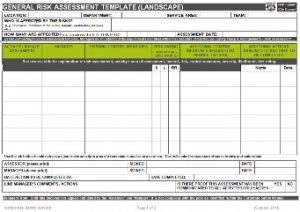
Manufacturers, competent persons and managers will all need to ensure that appropriate risk assessments have been completed for those risks associated to the initial design, installation and continued operation of the powered gates and doors.
Depending on the use of the powered gates and doors, the risk assessment should also identify the risks associated with the particular design and then this can identify the specific controls and safety features that will be required.